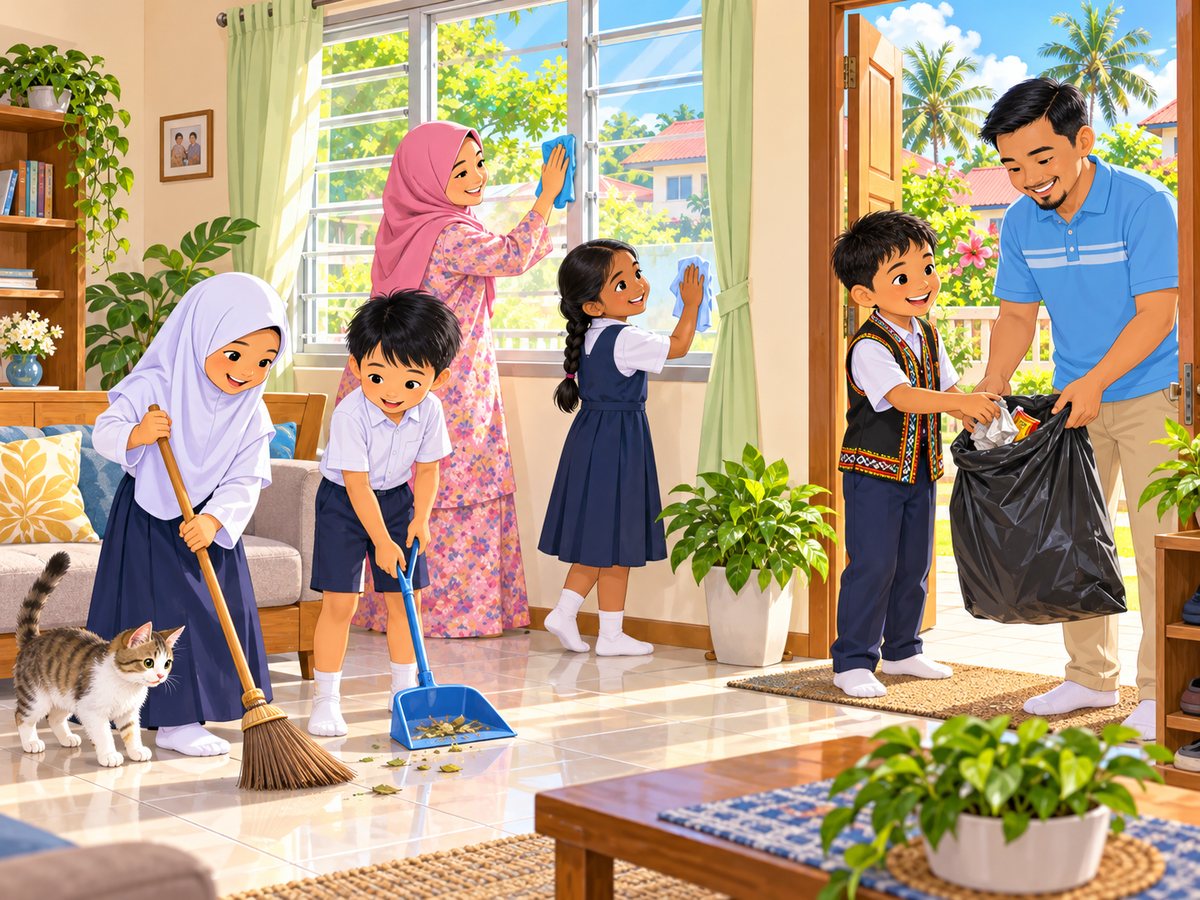
Berikan respons, fahami isi tersirat, tulis jawapan, kenal pantun dan gunakan kata adjektif bentuk.
Mendengar dan Bertutur
Berikan respons terhadap permintaan
Dengar permintaan hingga selesai, kenal tindakan yang diminta dan jawab dengan sopan. Respons yang baik menunjukkan kesediaan serta menyebut semula tindakan penting.
dengar → faham permintaan → jawab → lakukan
permintaan = 请求 听到请求时,先确认对方希望你做什么,再用礼貌的完整句子回应。把主要动作说出来,可以让对方知道你已经听懂。例子:听到“Tolong lap meja ini.”,可以回答“Baik, saya akan mengelap meja ini.”。注意:不要在对方说完前随意猜测任务。
permintaan = request. Listen until the speaker finishes, identify the requested action, and respond in a polite complete sentence. Repeating the key action shows that you understood it. Example: after “Tolong lap meja ini.”, you may say “Baik, saya akan mengelap meja ini.” Watch out: do not guess the task before the speaker has finished.
Membaca
Nyatakan isi tersirat
Isi tersirat tidak ditulis secara langsung. Gabungkan tindakan, sebab dan hasil dalam teks untuk membuat kesimpulan yang munasabah.
isi tersirat = implied information. It is not stated directly, so combine actions, reasons, and results from the text to infer a sensible idea. Use evidence before adding general knowledge. Example: when each family member cleans a different area, we may infer that they cooperate and share duties. Watch out: an inference needs textual support and must not be a personal guess.
Menulis
Tulis jawapan pemahaman
Baca kata tanya, cari bukti dalam petikan dan bina jawapan lengkap. Soalan bertumpu menggunakan fakta, manakala soalan bercapah memerlukan alasan yang munasabah.
jawapan pemahaman = comprehension answer. Identify whether the question asks who, what, why, or how, then locate the relevant evidence. A focused question uses a stated fact, while an open question also needs a sensible reason. Example: to explain how hands are kept clean, name both the action and useful materials. Watch out: do not copy the question or answer with one unrelated word.
Seni Bahasa
Kenal rima akhir dan jeda pantun
Rima akhir ialah bunyi yang sama pada hujung baris. Jeda ialah hentian pendek di tengah baris yang membantu pantun dilafazkan dengan jelas dan berirama.
hujung baris = rima · hentian / = jeda
rima akhir dan jeda = 尾韵与停顿 尾韵是诗行末尾相同或相近的声音,停顿则是在一行中间短暂停一下。朗读时先观察行末词,再按意义自然停顿。例子:两行分别以 pagi 和 lagi 结束,就有相近尾韵。注意:停顿不是把一个词拆开,也不是每两个词都停。
rima akhir dan jeda = end rhyme and pause. End rhyme is a matching or similar sound at the ends of lines. A jeda is a brief pause within a line that supports clear, rhythmic delivery. Example: lines ending in pagi and lagi share a similar final sound. Watch out: a pause must follow meaning; never split a word or stop after every two words.
Tatabahasa
Gunakan kata adjektif bentuk
Kata adjektif bentuk menerangkan rupa sesuatu benda. Perhatikan sisi, permukaan atau bentuk keseluruhan sebelum memilih perkataan yang tepat.
bulat · segi tiga · lonjong · silinder
kata adjektif bentuk = 形状形容词 形状形容词说明物体外形,例如圆形、三角形、椭圆形或圆柱形。先观察物体的边、面和整体轮廓,再选词。例子:硬币可说“syiling bulat”,长形鸡蛋可说“telur lonjong”。注意:颜色和大小不是形状,不能混作同一类别。
kata adjektif bentuk = shape adjective. It describes the form of an object, such as round, triangular, oval, or cylindrical. Observe the object's edges, surfaces, and overall outline before choosing a word. Example: a coin may be described as “syiling bulat”, while an egg is “telur lonjong”. Watch out: colour and size are different adjective categories, not shapes.
Semak cepat · Soalan 1 / 2
Apakah respons sopan terhadap permintaan ‘Tolong lap rak buku ini’?
respons permintaan = responding to a request. This quick check asks you to find a complete response that politely confirms and repeats the requested action. First locate the clue connected to respons permintaan, then compare the purpose of all three choices. Example: when asked to put toys away, agree politely and state that the tidying action will be done. Watch out: describing an object or a past event does not respond to the current request.
Semak cepat · Soalan 2 / 2
Setiap ahli keluarga melakukan tugas membersihkan rumah. Apakah isi tersiratnya?
isi tersirat = implied information. This quick check asks you to infer the shared value shown when every family member takes part in the cleaning duties. First locate the clue connected to isi tersirat, then compare the purpose of all three choices. Example: when group members complete different parts of a poster, their actions suggest cooperation. Watch out: the inference must be supported by the situation, not by invented details about moving or buildings.
Ringkasan
Syabas!
Kamu telah menamatkan Unit 7.
Baca, sebut dan tulis dengan teliti. Gunakan perkataan mengikut konteks.