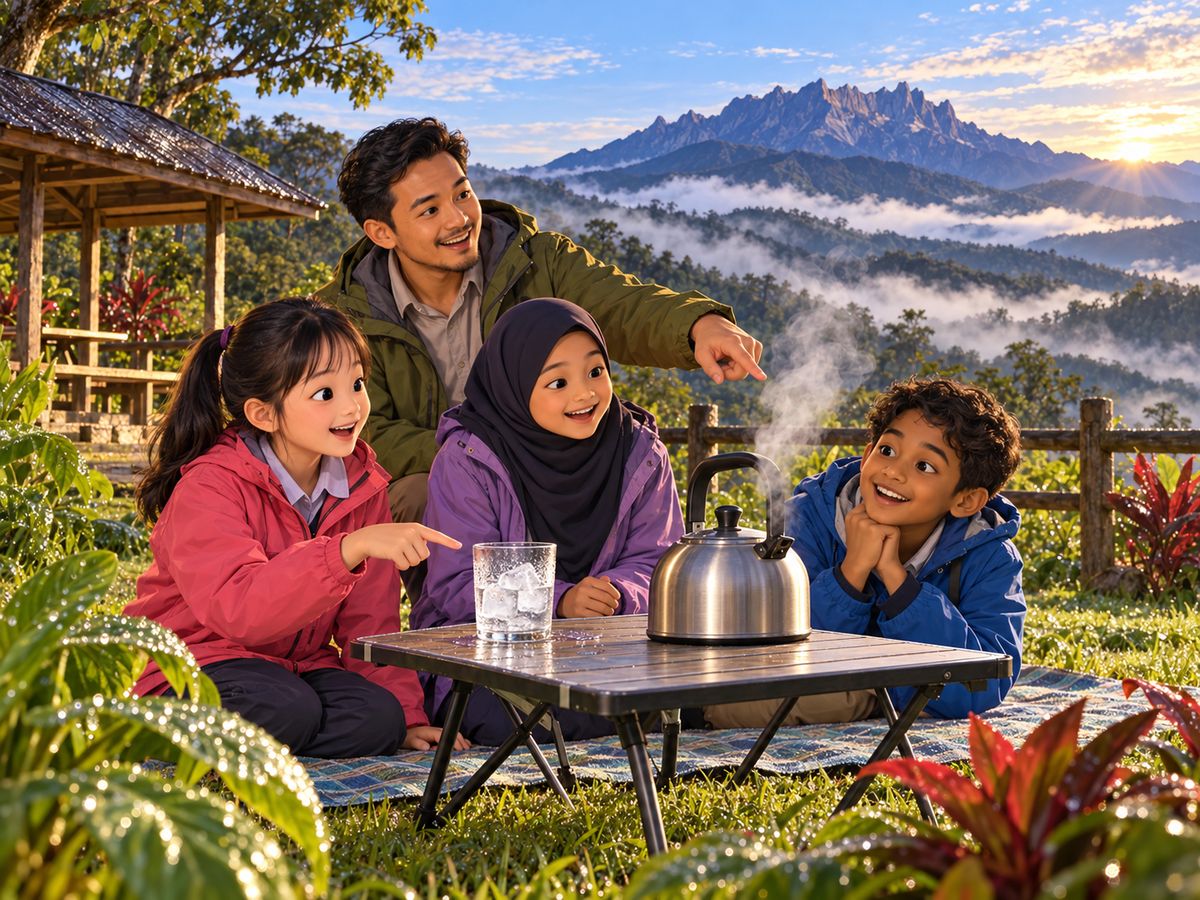
Haba matahari memanaskan air di sungai, tasik dan laut. Sebahagian air berubah menjadi wap air dan naik ke udara.
Langkah 1
Air menyejat menjadi wap air
Haba matahari memanaskan air di sungai, tasik dan laut. Sebahagian air berubah menjadi wap air dan naik ke udara.
air + haba matahari → wap air naik
Air menyejat = 水蒸发 太阳的热力把河、湖和海里的水晒热。一部分水变成水蒸气,升到空气中。我们看不到水蒸气,但会发现水变少了。例子:下雨后操场上的小水坑,出太阳几个小时后就干了。注意:蒸发不需要把水煮开,太阳晒也会蒸发。
Air menyejat = water evaporates The Sun's heat warms the water in rivers, lakes and seas. Some of the water changes into water vapour and rises into the air. We cannot see the vapour, but the water level drops. Example: A puddle on the field after rain dries up after a few sunny hours. Watch out: Water does not need to boil to evaporate; sunshine is enough.
Langkah 2
Wap air menyejuk membentuk awan
Di udara yang lebih sejuk, wap air berubah menjadi titisan air halus. Banyak titisan berkumpul membentuk awan.
wap air menyejuk → titisan → awan
Wap air menyejuk = 水蒸气变冷 水蒸气升到比较冷的高空,变回很小很小的水滴。许多小水滴聚在一起,就形成云。这一步和蒸发正好相反。例子:冰水杯外面会出现小水珠,是空气中的水蒸气遇冷变成的。注意:云是由小水滴组成的,不是棉花或烟。
Wap air menyejuk = water vapour cools High up where the air is colder, water vapour turns back into tiny water droplets. Many droplets gather together to form a cloud. This step is the opposite of evaporation. Example: Little drops appear on the outside of a glass of iced water, because vapour in the air cools and changes into water. Watch out: Clouds are made of tiny water droplets, not cotton or smoke.
Langkah 3
Hujan mengembalikan air ke bumi
Apabila titisan di awan menjadi berat, air turun sebagai hujan. Air mengalir semula ke sungai dan laut, lalu kitaran berulang. Kitaran air membekalkan air kepada hidupan dan menyejukkan bumi.
awan → hujan → sungai dan laut → ulang
Hujan mengembalikan air = 雨把水送回地面 云里的水滴越聚越多,变重了就落下来成为雨。雨水流回河流和大海。然后水又被晒热蒸发,循环一直重复。例子:花园被雨淋湿,几天后泥土又被太阳晒干。注意:水循环没有终点,一圈完了又重新开始。
Hujan mengembalikan air = rain returns water to Earth When droplets in a cloud join up and grow heavy, they fall as rain. Rainwater flows back into rivers and the sea, then warms up and evaporates again, so the cycle keeps repeating. Example: Rain soaks a garden, and a few days later the Sun dries the soil again. Watch out: The water cycle has no end point; once a loop finishes, it starts again.
Semak cepat · Soalan 1 / 2
Cuba sendiri
Pilih jawapan. Jika belum tepat, baca petunjuk dan cuba lagi.
Apakah yang menyebabkan air menyejat?
Apakah menyebabkan air menyejat = 什么让水蒸发 题目问是什么让水蒸发。回想第1步:河、湖、海的水是怎样被加热的。蒸发需要热,所以要找能给水带来热的东西。树荫和冷风会不会给水带来热,可以用来检查。例子:湿毛巾挂在有阳光的窗边,比放在阴暗角落干得快。注意:蒸发要靠热,阴凉的地方水干得比较慢。
Apakah menyebabkan air menyejat = what makes water evaporate The question asks what causes water to evaporate. Recall Step 1 and how water in rivers, lakes and seas gets warmed. Evaporation needs heat, so look for the thing that brings heat to water. Ask whether shade or a cool wind could bring heat to water. Example: A wet towel hung by a sunny window dries faster than one in a dark corner. Watch out: Evaporation needs heat; water dries more slowly in the shade.
Semak cepat · Soalan 2 / 2
Cuba sendiri
Pilih jawapan. Jika belum tepat, baca petunjuk dan cuba lagi.
Air yang menyejat menjadi...
Air yang menyejat = 蒸发的水 题目问水蒸发后变成什么。回想第1步:水被晒热后升到空气中,变成看不见的东西。想想它会变成石头、硬冰,还是会飘到空气中。例子:煮汤时锅上冒出白白的热气,那是从汤里的水来的。注意:蒸发的水还是水,只是样子变了。
Air yang menyejat = evaporating water The question asks what water becomes after it evaporates. Recall Step 1: warmed water rises into the air as something we cannot see. Think about whether it would turn into stone, hard ice, or float into the air. Example: When soup boils, steam rises above the pot, and it came from the water. Watch out: Evaporated water is still water; only its form has changed.
Ringkasan
Syabas!
Kamu telah belajar tentang Kitaran Air Semula Jadi.
Ingat: air menyejat menjadi wap air; wap air menyejuk membentuk awan; hujan mengembalikan air ke bumi.