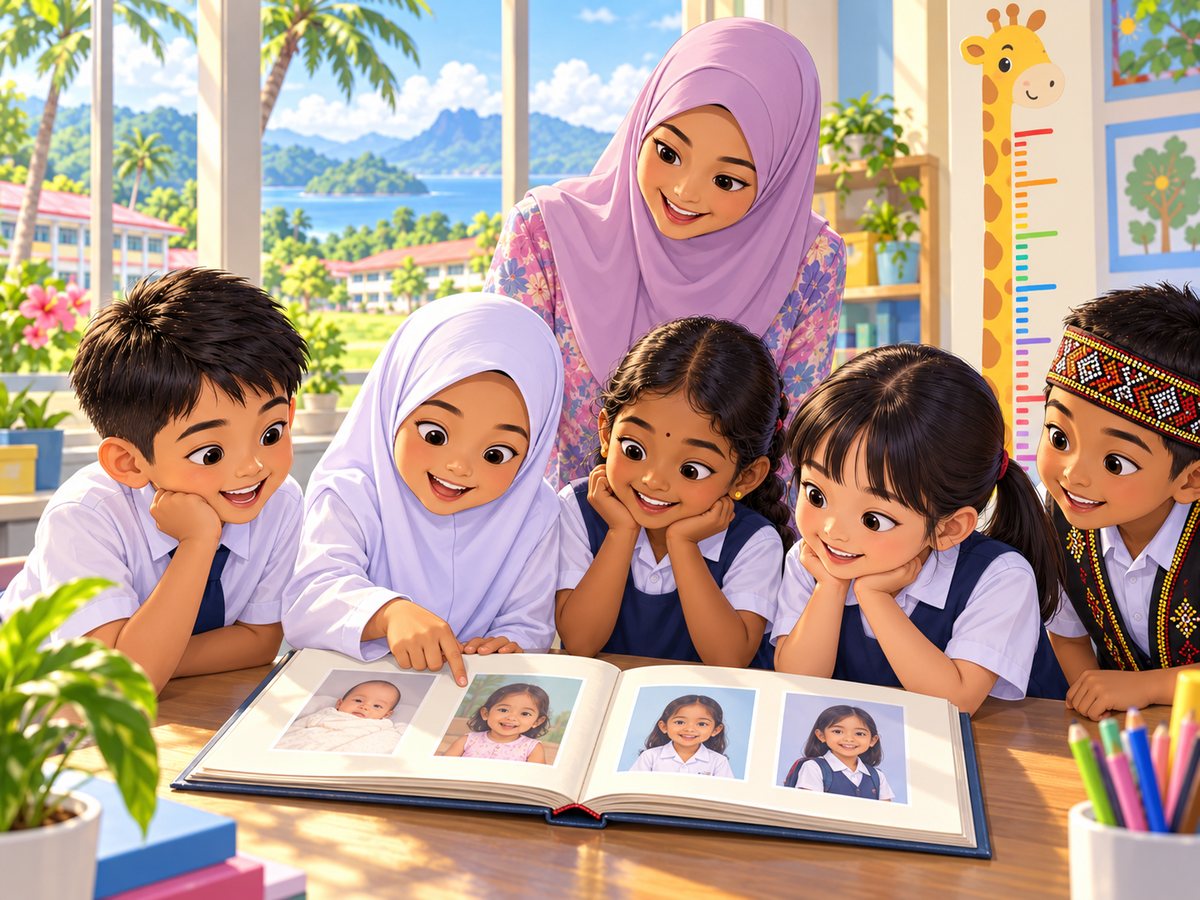
Manusia membiak dengan melahirkan anak. Urutan tumbesaran manusia ialah bayi, kanak-kanak, remaja dan dewasa.
Langkah 1
Pembiakan dan peringkat hidup
Manusia membiak dengan melahirkan anak. Urutan tumbesaran manusia ialah bayi, kanak-kanak, remaja dan dewasa.
melahirkan anak · bayi → kanak-kanak → remaja → dewasa
Pembiakan dan peringkat hidup = 繁殖和生命阶段 人类用生孩子的方式繁殖,宝宝从妈妈身体里出生。出生后,宝宝按婴儿、儿童、少年、成人的顺序长大。这一页把“怎样出生”和“怎样长大”一起复习。 例子:邻居阿姨生了宝宝,十几年后宝宝会长成少年。 注意:人不是从蛋里孵出来的,不要和鸡、鸭搞混。
Pembiakan dan peringkat hidup = reproduction and life stages Humans reproduce by giving birth; a baby is born from the mother's body. After birth the baby grows through the stages of baby, child, teenager and adult. This page reviews both how we are born and how we grow. Example: When a neighbour has a new baby, that baby will be a teenager in about thirteen years. Watch out: Humans do not hatch from eggs, so do not mix them up with chickens or ducks.
Langkah 2
Perubahan dan perbezaan tumbesaran
Saiz, tinggi dan berat berubah semasa membesar. Individu yang sama umur masih boleh mempunyai ukuran yang berbeza.
saiz · tinggi · berat berubah · individu sebaya berbeza
Perubahan dan perbezaan tumbesaran = 成长的变化和差异 长大时,身体大小、身高和体重都会改变。但同年纪的人,测量结果仍可以不同。 例子:哥哥九岁时 130 cm,十岁时 135 cm;他的同学十岁却是 140 cm。 注意:“会改变”和“人人不同”是两个不同的重点,不要只记一个。
Perubahan dan perbezaan tumbesaran = growth changes and differences When we grow, size, height and weight all change. Yet people of the same age can still have different measurements. So we compare one person's records over time, and we accept that others differ from us. Example: A brother was 130 cm at nine and 135 cm at ten, while his ten-year-old friend is 140 cm. Watch out: Changing over time and differing between people are two separate ideas; remember both.
Langkah 3
Ciri yang diwarisi
Anak boleh mewarisi warna kulit, warna mata dan jenis rambut daripada ibu, bapa atau keturunan. Setiap individu tetap mempunyai gabungan ciri tersendiri.
keturunan → warna kulit · warna mata · jenis rambut
Ciri yang diwarisi = 遗传的特征 孩子可以从爸爸、妈妈或祖先那里遗传肤色、眼睛颜色和头发类型。不过每个人的特征组合都不一样,所以就算是兄弟姐妹,样子也不完全相同。 例子:两兄妹都是黑眼睛,可是哥哥直发,妹妹卷发。 注意:兄弟姐妹不是双胞胎复印本,有相同也有不同的特征。
Ciri yang diwarisi = inherited traits A child can inherit skin colour, eye colour and hair type from the mother, father or earlier family. Still, each person has a unique mix of traits, so even brothers and sisters do not look exactly alike. Example: A brother and sister both have black eyes, but he has straight hair and she has curly hair. Watch out: Siblings share some traits but not all, so expect both matches and differences.
Semak cepat · Soalan 1 / 2
Cuba sendiri
Pilih jawapan. Jika belum tepat, baca petunjuk dan cuba lagi.
Manusia membiak dengan cara...
Cara manusia membiak = 人类繁殖的方式 这题问人类用什么方式产生下一代。想想你是怎样来到世界的:从妈妈身体出生,还是从蛋或种子开始? 例子:芒果树从种子长出来,鸭子从蛋里孵出来,各有各的方式。 注意:其他生物的繁殖方式也会出现在选项里,要选属于人类的。
Cara manusia membiak = how humans reproduce This question asks how humans produce the next generation. Think about how you came into the world: born from your mother's body, or starting as an egg or a seed? Example: A mango tree grows from a seed and a duckling hatches from an egg; each living thing has its own way. Watch out: Ways that other living things reproduce also appear in the choices, so pick the human one.
Semak cepat · Soalan 2 / 2
Cuba sendiri
Pilih jawapan. Jika belum tepat, baca petunjuk dan cuba lagi.
Apakah urutan peringkat hidup yang betul?
Urutan peringkat hidup = 生命阶段的顺序 这题要选出人的四个生命阶段排得对的一组。方法:先确认年纪最小的阶段排第一,再看后面是不是一个比一个大。 例子:给照片排顺序:抱在怀里的宝宝、背书包的小学生、中学生、上班的爸爸。 注意:三组的词都一样,只是顺序不同,要一个一个比对位置。
Urutan peringkat hidup = order of life stages This question asks you to choose the set where the four human life stages are in the right order. Check that the youngest stage comes first and that each next stage is older. Example: Order photos: a baby in arms, a primary pupil with a school bag, a secondary student, then a working father. Watch out: All three sets use the same words in different orders, so compare each position carefully.
Ringkasan
Syabas!
Kamu telah mengulang kaji bab Manusia.
Ingat: pembiakan dan peringkat hidup; perubahan dan perbezaan tumbesaran; ciri yang diwarisi.