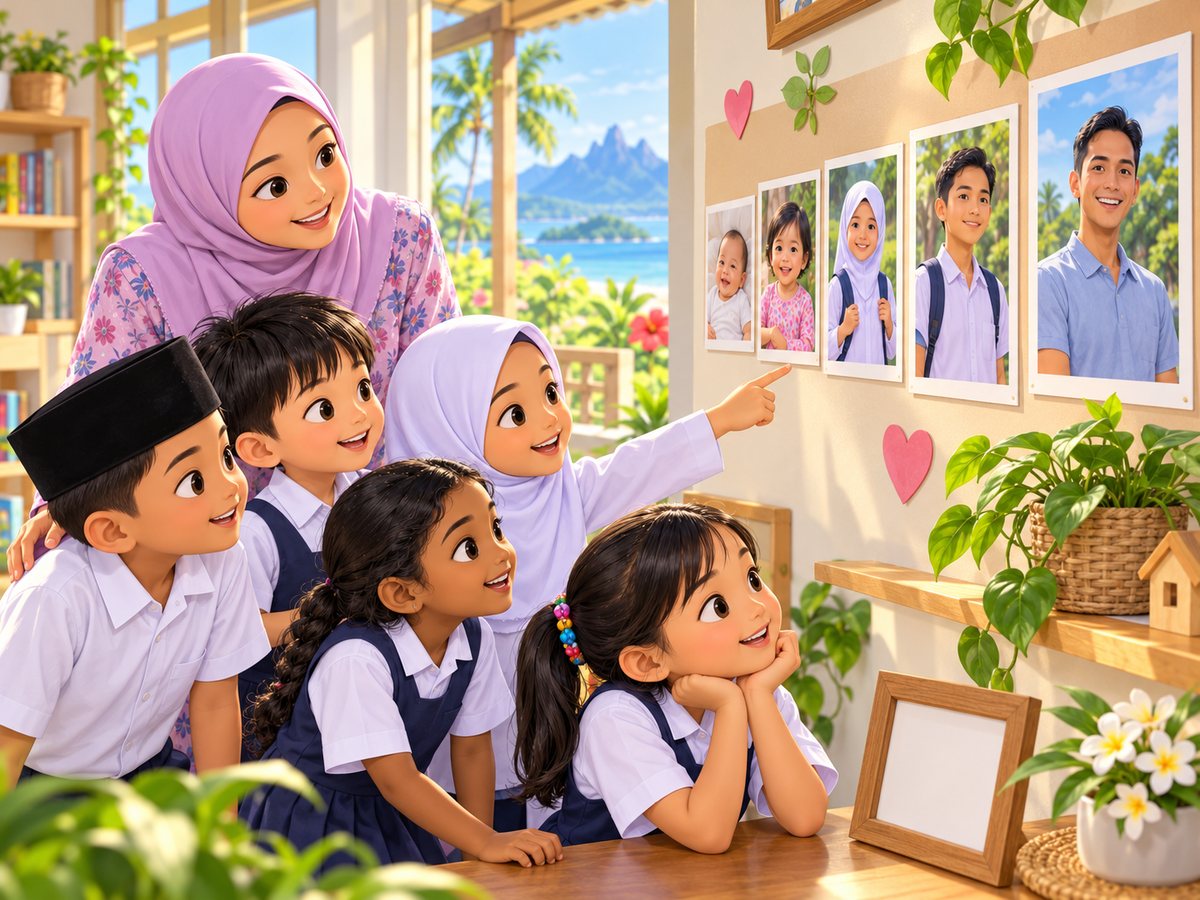
Urutan tumbesaran manusia ialah bayi, kanak-kanak, remaja dan dewasa. Setiap peringkat berlaku selepas peringkat sebelumnya.
Langkah 1
Peringkat tumbesaran manusia
Urutan tumbesaran manusia ialah bayi, kanak-kanak, remaja dan dewasa. Setiap peringkat berlaku selepas peringkat sebelumnya.
bayi → kanak-kanak → remaja → dewasa
Peringkat tumbesaran manusia = 人的成长阶段 人长大要按顺序经过四个阶段:婴儿、儿童、少年、成人。每个阶段接在前一个后面,不能跳过,也不会倒回去。 例子:表弟现在是婴儿,几年后上学成为儿童,后来变成少年。 注意:remaja 是少年,要排在 kanak-kanak 后面。
Peringkat tumbesaran manusia = stages of human growth Every person passes through four stages in a fixed order: bayi (baby), kanak-kanak (child), remaja (teenager) and dewasa (adult). Each stage follows the one before, so nobody skips a stage or goes backwards. Follow the arrows to read the order. Example: A baby cousin will become a schoolchild in a few years, and later a teenager. Watch out: Remaja means teenager, so it comes after kanak-kanak, never before it.
Langkah 2
Saiz dan tinggi berubah
Apabila seseorang membesar, saiz badan bertambah dan badan menjadi lebih tinggi. Bandingkan rekod pada masa berlainan untuk melihat perubahan.
masa bertambah → saiz bertambah · tinggi bertambah
Saiz dan tinggi berubah = 身体大小和身高会改变 人长大时,身体变大也变高。把不同时间的记录拿来比较,例如去年和今年的身高,数字变大就是成长的证据。 例子:门框上的身高线,一年级在 110 cm,二年级到了 116 cm,长高了 6 cm。 注意:只看一次记录看不出变化,一定要比两个不同时间的记录。
Saiz dan tinggi berubah = body size and height change As we grow, our body gets bigger and taller. To see the change, compare records from different times, such as your height last year and this year. Bigger numbers are evidence of growth. Example: A pencil mark on the door showed 110 cm in Year 1 and 116 cm in Year 2, so the child grew 6 cm. Watch out: One record alone shows no change; you need two records from different times.
Langkah 3
Berat juga berubah
Berat badan biasanya bertambah semasa membesar. Saiz, tinggi dan berat ialah tiga perubahan yang boleh diperhatikan atau diukur sejak lahir.
membesar = saiz ↑ · tinggi ↑ · berat ↑
Berat juga berubah = 体重也会改变 长大时体重通常也会增加。所以从出生起,有三种变化可以观察或测量:身体大小、身高和体重。身高用尺量,体重用秤称。 例子:婴儿出生时约 3 kg,一岁时约 9 kg,大约变成三倍。 注意:体重要用秤称,不能用眼睛猜;kg 是体重单位,cm 是身高单位。
Berat juga berubah = body weight changes too While growing up, body weight usually increases as well. So from birth there are three changes we can observe or measure: size, height and weight. Height is measured with a tape, weight with a scale. Example: A newborn may weigh about 3 kg and about 9 kg at one year old. Watch out: Weight must be measured on a scale, not guessed, and kg is for weight while cm is for height.
Semak cepat · Soalan 1 / 2
Cuba sendiri
Pilih jawapan. Jika belum tepat, baca petunjuk dan cuba lagi.
Urutan tumbesaran = order of growth This question asks for the correct order of the four human stages, from youngest to oldest. The clue is that everyone starts life newly born and becomes a grown-up last. Read each choice from left to right and check that each stage follows the one before. Example: Sort family by age: sister 3, brother 10, cousin 15, father 40. Watch out: A correct first word is not enough; all four stages must be in order.
Semak cepat · Soalan 2 / 2
Cuba sendiri
Pilih jawapan. Jika belum tepat, baca petunjuk dan cuba lagi.
Apakah peringkat selepas bayi?
Peringkat selepas bayi = 婴儿之后的阶段 这题只问紧接在婴儿后面的阶段,不是最后的阶段。selepas 的意思是“之后、下一个”。先在心里排好四个阶段,再找婴儿后面的第一格。 例子:星期一之后是星期二,不是星期五。 注意:不要跳过中间的阶段,直接选年龄更大的答案。
Peringkat selepas bayi = the stage after baby This question asks only for the stage right after a baby, not the final stage. The key word selepas means after or next. Line up the four stages in your head, then point to the very next one after baby. Example: The day after Monday is Tuesday, not Friday. Watch out: Do not jump over a stage and pick an older age just because it sounds grown-up.
Ringkasan
Syabas!
Kamu telah belajar tentang Saya Membesar.
Ingat: peringkat tumbesaran manusia; saiz dan tinggi berubah; berat juga berubah.